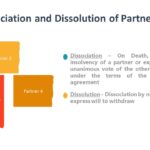
Dissolution Dissolution can occur by an agreement of the partners to end the partnership. Although the actual authority to act on behalf of the partnership ceases at dissolution, apparent authority to conduct business in the usual way continues until notice is given to third parties or the partnership business winds up. A partner’s liability for […]
Continue readingAuthor Archive: niyatihemani
Generation Skipping Transfer Tax
The Generation-Skipping Transfer Tax is imposed separately and in addition to gift and estate taxes on transfers directly or in trust for the sole benefit of a person at least two generations younger than the transferor. A generation-skipping transfer is defined as a taxable termination, a taxable distribution, or a direct skip [Sec. 2611(a)]. A […]
Continue readingEstate Income Tax vs Estate Tax
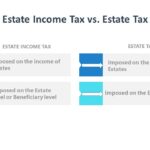
Estate Income Tax Estate Income Tax – Imposed on the income of estates. Imposed on the estate level or beneficiary level An estate (or trust) with a gross income of at least $600 is required to file Form 1041, Income Tax Return for Estates and Trusts, no later than the 15th day of the 4th month […]
Continue readingGift Tax
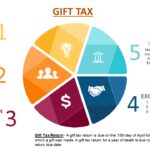
The gift tax is a tax of the transfer of a gift imposed on the donor. A gift is complete when the donor has so parted with dominion and control as to leave him or her no power to change its disposition. The amount of a gift made in property is the fair market value […]
Continue readingSimple and Complex Trusts
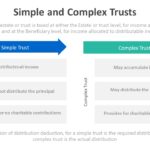
Simple Trust – A simple trust is formed under an instrument that (1) requires current distribution of all its income, (2) requires no distribution of the res (i.e., principal, corpus), and (3) provides for no charitable contributions by the trust. Complex Trust – A Complex Trust is a Trust that permits accumulation of current income, […]
Continue readingInvoluntary Conversions
A taxpayer may elect to defer recognition of gain if property is involuntary converted into money or property that is similar or related in service or use. An involuntary conversion of property results from destruction, theft, seizure, requisition, condemnation, or threat of imminent requisition or condemnation. When a property is converted involuntarily into nonqualified proceeds […]
Continue readingSale of Principal Residence
Section 121 provided an exclusion upon the sale of a principal residence. No loss may be recognized on the sale of a principal residence. Two tests to qualify for exclusion of gain upon principal residence are: Ownership test – Taxpayer has owned the residence for 2 of the 5 prior years Use test – Taxpayer […]
Continue readingLike Kind Exchanges
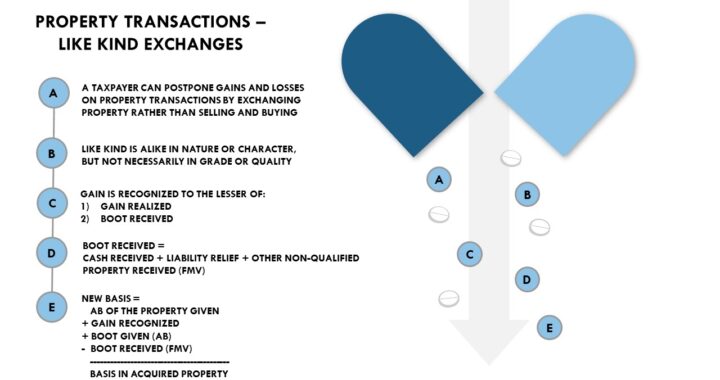
Section 1031 defers recognizing gain or loss to the extent that real property productively used in trade or business or held for production of income (investment) is exchanged for property of like kind. Only real property qualifies for like kind exchange.
Like-kind refers to the nature or character of the property. Real estate for real estate qualifies as a like-kind exchange even if the properties are as different as a rental office building and a parking lot, or even if the properties are located in different states. All other property, including stocks (and other securities and debt instruments) and partnership interests, is excluded from qualifying for like-kind exchange treatment.
Boot is all nonqualified property transferred in an exchange transaction. Boot received includes cash, net liability relief, and other nonqualified property (its FMV).
Recognized Gain = Lesser of gain realized or boot received
Deferred gain = Realized gain – Recognized gain
Deferred loss = Realized loss
Basis of acquired property = AB of property given + Gain recognized+ Boot given – Boot received
OR
Basis of acquired property = FMV of acquired property – Deferred gain + Deferred loss
Related Party Sales
Limited Tax Avoidance Rules limit tax avoidance between related parties. Gain recognized on an asset transfer to a related person in whose hands the asset is depreciable is ordinary income. Loss realized on the sale or exchange of property to a related person is not deductible. Under Sec. 267, losses are not allowed on sales […]
Continue readingSmart Business Stock Exclusion
Stock qualifies as Section 1202 stock if it is received after August 10, 1993, the corporation is a domestic C corporation, the seller is the original owner of the stock, and the corporation’s gross assets do not exceed $50 million at the time the stock was issued. Additional requirements do exist. However, the total gross assets […]
Continue reading